


Meet Keri Stephens
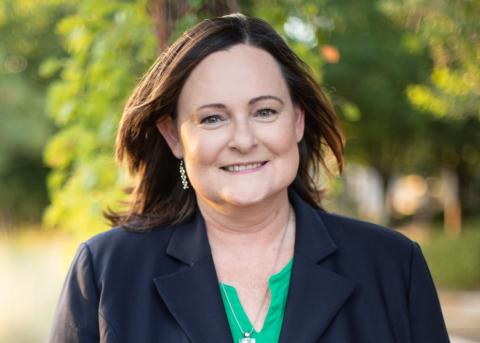
With a professional career that includes a biochemistry degree, a stint as a Hewlett-Packard field engineer and early-1990s work with robotics and artificial intelligence, Distinguished Teaching Professor Keri Stephens, Ph.D., packs real-world perspective into her communication classes.
Although she loved the challenges of her early technical career, she turned to graduate school at UT Austin to learn how to reach more people with useful information.
“All of the science jargon was so hard for people to understand. My passion has always been communicating really complicated science to lay audiences.”
In her late 20s, Stephens quit her tech job to begin graduate studies at UT’s Moody College of Communication.
“The topics that I studied were the ever-expanding forms of communication technology. I've published about mobile phones, web conferencing, human and artificial intelligence teaming. When we talk about technologies, I have this deep-seated desire to make sure everybody can understand.”
Combining academics and industry
Eventually, her curiosity and determination lead to completing her doctorate degree at UT Austin and her position in the Moody College of Communication, where she has taught for nearly 20 years. She is the George Christian Centennial Professor in Organizational Communication & Technology, co-director of the Technology and Information Policy Institute and founding co-chair of the joint McCombs-Moody Professional Sales & Business Development Minor.
Her teaching has been honored at the University level with the President’s Associates Teaching Excellence Award, the Eyes of Texas Teaching and Mentoring Award and the Academy of Distinguished Teachers at UT Austin.
“The way the academic world and industry function are quite often very different, and I love the idea of taking what I know from theory and research and making it something that is practical, applicable and very real-world relevant.”
- Professor Keri Stephens
Never routine
As a teacher, she hates wasting time and brings energy to the classroom.
“My students will say that I keep them engaged and that it is worth the effort they put into learning.” Don’t call her classes routine.
As a teacher, she hates wasting time and brings energy to the classroom.
“My students will say that I keep them engaged and that it is worth the effort they put into learning.” Don’t call her classes routine.
“I never lecture for more than a short period of time. Then, we do some kind of an activity. We turn to a person beside us. We have a handout that we're working on. We get up and walk around.”
Stephens values mutual respect and learning from others. Sometimes, she creates teams or other classroom environments that allow students to share ideas.
Students appreciate this approach, in fact there is usually a waiting list for her courses in Organizational Communication, Communication Technologies, Grant Writing, Communicating to Build Sales Relationships and Communication Studies.
Calls herself quirky
Stephens has been known to play ‘80s music in the classroom. She calls herself quirky and doesn’t apologize that her “modern” word use sometimes make students giggle. “By the way, cool is not the ‘in’ word right now. They told me. But that’s OK, I’m not trying to compete with them.”
“Y’all” is one of this native Texan’s favorite words and she uses it a lot in the classroom.
“There is no better word in the English language than y'all. It's gender neutral. It works for singular or plural. It is quick and to the point. It's a great word!”
Ultimately, Stephens takes a straightforward approach to teaching. “I'm very authentic. I go into every setting telling people what my motives are. I don't beat around the bush. I do that in my research, too.”
Current research: People first
Flooding and crisis are the center of her current research. Since Hurricane Harvey hit the Texas coast in 2017, her efforts have resulted in more than $10 million in external research funding. She focuses on Texas: “We’re No. 1 in flooding.”
The life-altering power of a Texas flood drives her passion to help people. She was a third grader living in South Bend, Texas, when her family survived the 1978 flood of the Clearfork of the Brazos River.
“We had 5 feet of water in our house for three weeks. We lost everything.”
Her dream is to create a Center for People and Complex Disasters. “People are deliberately first because that’s who I believe in.”
When Harvey hit, Stephens’ skills came into focus. “What I knew about technology could help people. I understood social media, I understood mobile phones, I understood a lot of the tools that could be used in these settings. I ended up getting my first National Science Foundation grant and got to work.”
Stephens’ research and teaching pull together her worlds of technology, communication and personal experiences.
“I have confidence in people's abilities to help one another through these horrible situations, and that is where I want my research to do good in the world.”
More about Keri D. Stephens
Books
• “Handbook of Infrastructure Communication: Bridging Technical and Social Dimensions” (Coming in 2026, Wiley)
• “The Social Scientist’s Grant Guide: Strategies for Funding Research Frontiers” (Coming in 2026, Bloomsbury)
• “New Media in Times of Crisis” (2019, Routledge)
• “Negotiating Control: Organizations and Mobile Communication” (2018, Oxford University Press)
Research funding and activities
• Dozens of National Science Foundation (NSF), industry, state and industrial grants
• More than 30 international and US-based keynote talks and a TEDxTalk
• International Communication Association (ICA) Fellow
• Distinguished Partner, Institute for a Disaster Resilient Texas, Houston, TX
• Contributor to the Texas Integrated Flooding Framework
• Former Chair of the ICA Mobile Communication Division, Chair of the Training and Development Division of NCA
• Associate Editor for Management Communication Quarterly